I Wasn't Programming Pre-AI
Bart in 't Veld | L |
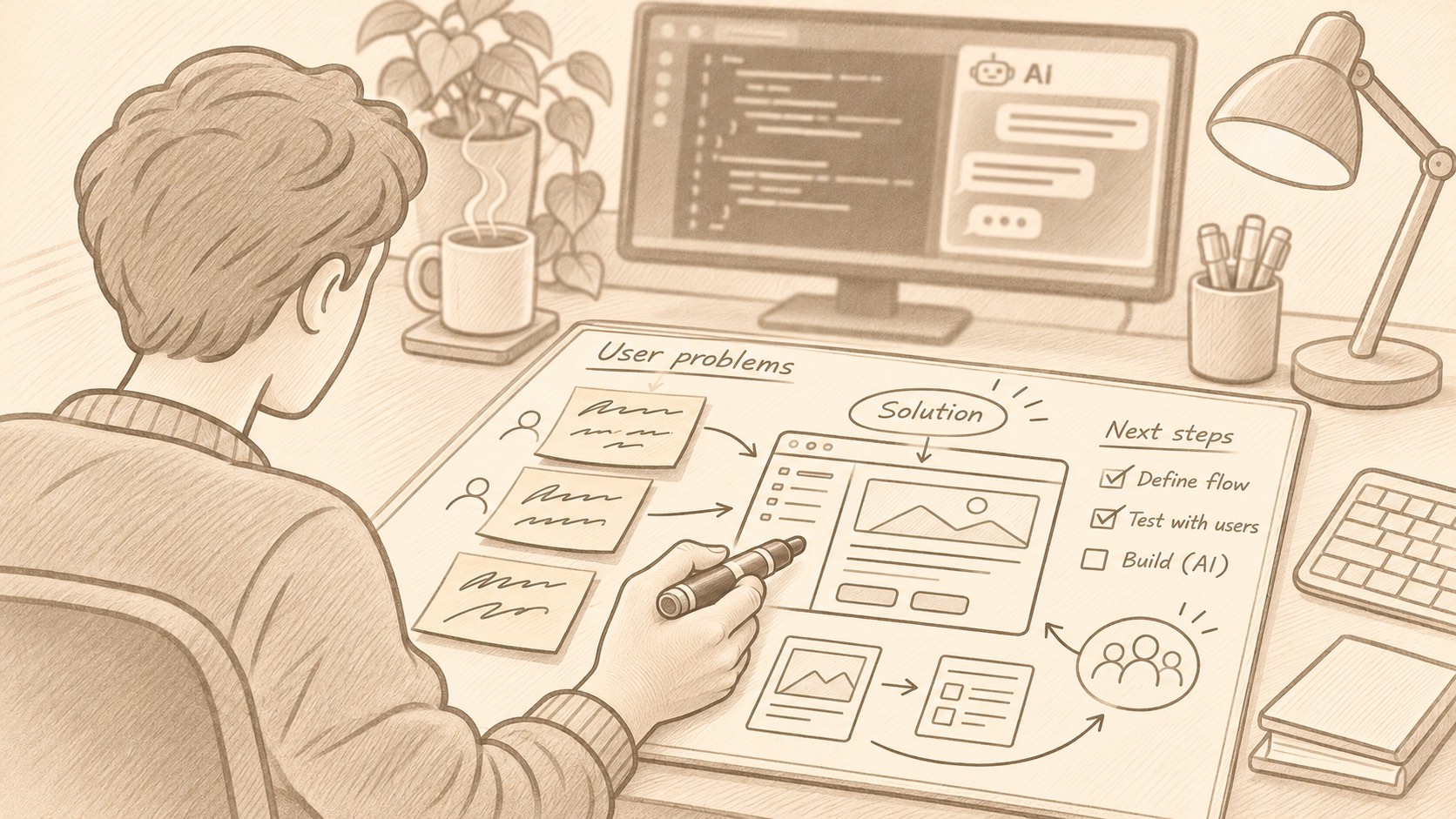
There's a sentiment going around in our field that I keep running into: developers who feel AI is taking the joy out of their work. The craft of programming is disappearing, and with it the satisfaction of solving a tricky problem in code. I understand where that feeling comes from. But every time I read one of those posts, I come to the same conclusion about myself. I wasn't programming before AI either. Not really. I was solving problems, and AI has only made me faster at it.
Instead of just mourning what we might be losing, in this article I want to look at what the job actually was all along, and why I think AI brings us closer to it rather than further away.
Killing Your Darlings
Let me tell you about my time in game development. During my studies I worked as a game designer and game developer, and anyone who has built a game knows the pattern. You get an idea, you start prototyping, and before you know it, weeks have turned into months. Somewhere along the way you stop testing the idea and start believing in it.
That isn't stupidity, it's sunk cost. When you've poured months of your life into a prototype, it becomes the solution in your head, simply because you've lived with it for so long. Then players finally get their hands on it, and it just doesn't land.
Game developers have a saying for this: kill your darlings. It's good advice, but it's brutal advice when your darling cost you half a year. Today that same idea could be a working prototype in a day, and in front of players by the end of the week. If it doesn't work, I can let it go without any heartbreak, because I haven't had the time to fall in love with it yet. That leaves room for a big refactor, or a completely different idea. Killing your darlings becomes a lot easier when they're cheap.
You're Not a Programmer, You're a Problem Solver
One of the lessons ingrained into my mind during my IT school days was this: you're not a programmer, you're a problem solver. The code was never the point. The point was the user on the other end, with a problem that needed solving.
That's why AI doesn't feel like a loss to me. The little puzzles inside a programming language were never what drove me. What drove me was the moment something actually worked for someone. As I wrote in The AI Acceleration Paradox, AI doesn't replace what we bring to the table, it accelerates it. It gets me to that moment sooner, and lets me try more ideas along the way.
There is a flip side, though, programmers have always had a reflex to automate. Give us a problem and we reach for software. Now that AI makes building software this easy, that reflex is stronger than ever. Being a problem solver also means admitting that sometimes the answer isn't software at all. Sometimes the right move is to push back on a customer and ask whether the process they want to automate should exist in the first place. Maybe that's the Dutch directness in me, but I was taught that challenging the question is part of the job.
The Approval Nobody Was Really Using
A while ago we were rebuilding a legacy system for a client. One of the things they really wanted to keep was a four-eyes principle: certain actions, like deleting something, needed approval from a second user.
On paper, that makes perfect sense. But as we talked it through, something odd came up. Every user had a second account sitting right next to them. They performed the action with one account and approved it with the other. The four-eyes principle existed in the software, but in practice everyone was approving their own work.
So we advised the client to let it go. Their people were already working around it. Give users more power, and trust them to make the right call.
Now imagine that same project with AI. Rebuilding that approval flow would take an afternoon. It would work flawlessly, and it would be completely pointless. The tool would never ask whether anyone actually used it. That question came from people talking to people. The more of the building gets automated, the more that kind of judgement becomes the real job.
To Be Fair to the Puzzle Lovers
I don't want to wave away the other side. Some people genuinely love the puzzle itself: the elegant algorithm, the clever bit of code, the deep dive into how a language works under the hood. That joy is real, and it's completely fair to miss it.
But I'd argue the craft was never just typing the code. The craft was understanding the problem, choosing what to build, and knowing what not to build. None of that has gone anywhere.
An Exciting Time to Start
This is something I tell my peers all the time: I'm genuinely excited for the next generation of software engineers. I'm not blind to the hard parts. Starters right now are having a tough time finding a job. They may miss some of the depth we picked up by grinding through certain technologies. And most schools haven't caught up yet.
But once schools embrace these tools and teach people how to use them properly, I think starters will grow faster than any generation before them. Less time fighting syntax, more time on what actually matters: users, problems, and judgement.
I was lucky. Years ago, a teacher told me I wasn't a programmer, I was a problem solver. Back then it was a nice bit of perspective. Today it's the lesson every school needs to teach. AI didn't change what the job is. It just made it obvious.